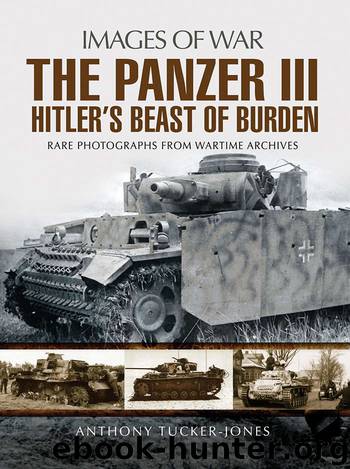
Panzer III: Hitler's Beast of Burden: 3 (Images of War) by Anthony Tucker-Jones
Author:Anthony Tucker-Jones [Tucker-Jones, Anthony]
Language: eng
Format: azw3
Publisher: Pen and Sword
Published: 2017-05-31T04:00:00+00:00
Command Tanks
The Panzer III was also used a Panzerbefehlswagen or command vehicle. Hundreds of these were produced but by 1944 they were increasingly in short supply due to the end of Panzer III gun tank production. To make up the shortfall, the German Army had little choice but convert existing Panzer IVs to Panzerbefehlswagen mit 7.5cm KwK L/48.
Five different types of Panzerbefehlswagen III were produced for the Panzerwaffe. About half these Panzer III command vehicles did not have a main gun in order to create additional interior space. This meant they were reliant on a single machine gun for protection and were at risk if they got too close to the action. In contrast, the Panzer IV command vehicle retained its 75mm gun.
Panzerbefehlswagen Ausf D¹
From the creation of Hitler’s panzer regiments in the mid-1930s it was apparent that an armoured command vehicle was needed to exercise tactical control over the tanks. The very first was the Kleine Panzerbefehlswagen (light armoured tracked command vehicle) based on the Panzer I chassis. But this did not provide enough work space so it was decided to create a grosse Panzerbefehlswagen (large armoured command vehicle) using the Panzer III as the basis. This was on the grounds that the Panzer II was likewise too small for the role. The Panzer I and II could only accommodate two and three crew respectively.
On the factory floor the Ausf D was adapted by simply omitting the 37mm gun and ammunition racks, then fixing the turret rigidly in place, to create extra radio and work space. The hull machine gun was also replaced by a pistol port. The vehicle took a crew of five like the regular gun tank, but comprising a commander, executive officer, two radio operators and the driver. The radio fit included the FuG6 (Funkgerät – radio equipment) tactical command set (replacing the FuG5), plus the FuG7 ground-to-air set with a range of 50km or the FuG8, the main divisional link set, with a range of 40km. To help with visibility the superstructure sides were fitted with extra vision and pistol ports.
In an effort to avoid enemy attention, the mantlet was fitted with a dummy 37mm gun barrel to give the impression from a distance at least that it was a regular gun tank. Nevertheless, the prominent square frame radio antenna fitted to the engine deck readily revealed its command role. The tank’s only defence was a single machine gun in the mantlet and the 30mm armour was largely inadequate. Some thirty Panzer III Ausf D¹ command vehicles were completed by Daimler-Benz during June 1938 to March 1939.
The plan was that each panzer unit Stab (HQ) up to brigade level would be issued with a grosse Panzerbefehlswagen, but production levels could not meet such demand. By 1 September 1939 just thirty-eight Pz Bef Wg Ausf D¹ and Ausf E were available, which was not enough to go round. Although the Ausf D¹ continued in service during the Western campaign of 1940, it was retired the following year because of the troublesome suspension with its eight road wheels either side.
Download
This site does not store any files on its server. We only index and link to content provided by other sites. Please contact the content providers to delete copyright contents if any and email us, we'll remove relevant links or contents immediately.
| Africa | Americas |
| Arctic & Antarctica | Asia |
| Australia & Oceania | Europe |
| Middle East | Russia |
| United States | World |
| Ancient Civilizations | Military |
| Historical Study & Educational Resources |
The Radium Girls by Kate Moore(12036)
100 Deadly Skills by Clint Emerson(4932)
Rise and Kill First by Ronen Bergman(4797)
The Templars by Dan Jones(4695)
The Doomsday Machine by Daniel Ellsberg(4493)
The Rape of Nanking by Iris Chang(4224)
Killing England by Bill O'Reilly(4008)
Stalin by Stephen Kotkin(3973)
Hitler in Los Angeles by Steven J. Ross(3949)
12 Strong by Doug Stanton(3555)
Hitler's Monsters by Eric Kurlander(3352)
Blood and Sand by Alex Von Tunzelmann(3207)
The Code Book by Simon Singh(3197)
Darkest Hour by Anthony McCarten(3137)
The Art of War Visualized by Jessica Hagy(3014)
Hitler's Flying Saucers: A Guide to German Flying Discs of the Second World War by Stevens Henry(2759)
Babylon's Ark by Lawrence Anthony(2686)
The Second World Wars by Victor Davis Hanson(2529)
Tobruk by Peter Fitzsimons(2521)
